
Text editing and soft skills training for research scientists

You are here: HOME >Workshops
Workshops provide an interactive learning environment which stimulates participants to generate their own ideas and solutions while effectively integrating the concepts and skills being taught.
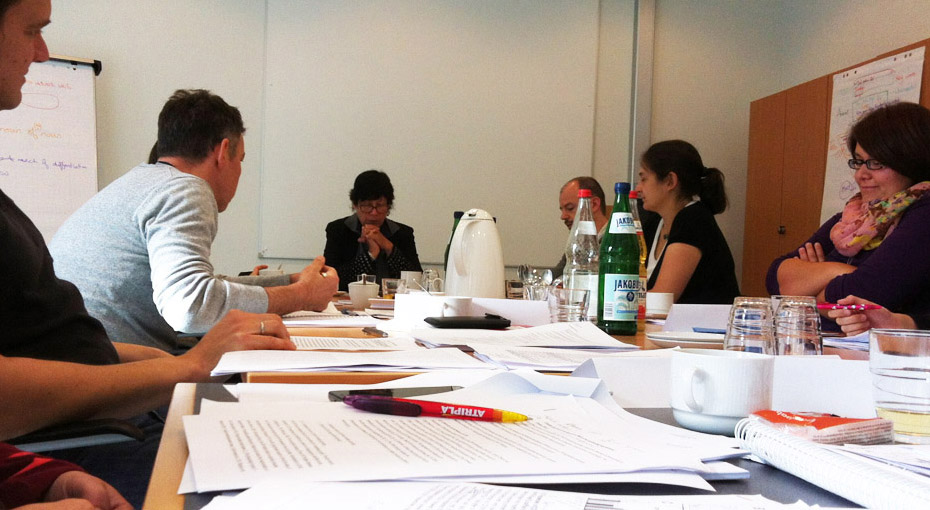
Workshops are generally agreed to be more effective for acquiring knowledge than less interactive courses, seminars, or simply reading up on material.
Workshop modules:
- SCIENTIFIC WRITING: Manuscripts
- SCIENTIFIC WRITING: Project proposals
- ORAL PRESENTATIONS
- POSTER PRESENTATIONS
Download Workshop Descriptions:
Target groups
Early PhDs:
With little or no scientific writing or presentation experience, and those writing PhD project proposals in their first year of a structured graduate programme.Senior PhDs:
Who are involved in writing papers, and are writing abstracts for meetings and conferences.Postdoc researchers, group leaders:
Who are writing their own papers, attending meetings and conferences, or writing their own research proposals for funding.Although designed for non-native English speakers, fluency in English is still no guarantee of good writing or presentation style or skills!
Each participant receives a certificate of participation after the workshop.
Workshop information
Workshops are designed for small groups of researchers in life sciences and molecular medicine.
Workshops are best suited for small groups (8 to maximum 12 participants) over 2 to 3 days, depending on the requirements and aims of the group.
Advice for organizers
It is important that everyone in the group can relate to the material supplied, to be able to apply the skills learned to their own writing or presentation and in their future research career.It is therefore essential to organize a target group comprising participants in the same field with about the same level of writing or presentation experience.
Please indicate these when booking a workshop.
Workshop material
Each participant receives a copy of the workshop handout containing detailed descriptions and examples of the material covered in the workshop, plus worksheets designed to provide practice in the skills being presented.Workshop groups
The focus of a workshop is always tailored to suit the needs of individual target groups.For optimal participant benefit the group should be as homogenous as possible in terms of experience, field of research, and English language competency. This ensures the needs of all the participants are addressed.
Workshop modules
Workshop modules are usually booked individually, e.g. Scientific Writing for Manuscripts.This allows the participants to master the material before before moving on to another topic, in a subsequent workshop, such as oral presentations.
However, modules can be combined in more intensive, but less comprehensive training, spanning three days.
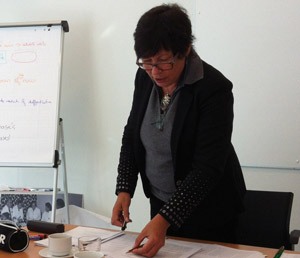
Trainer's profile
Dr. Avril Arthur-Goettig has many years of experience in scientific research, supervising students, and subsequently as a freelance scientific editor and trainer.About bioxpress